







PARA peneliti telah berhasil mengembangkan teknik deteksi HIV terbaru yang cukup murah dengan menggunakan pemindai (scanner) yang ada di DVD player. Peneliti di School of Biotechnology di KTH Royal Institute of Technology di Stockholm, memanfaatkan optik yang ada di DVD player untuk memindai HIC/AIDS.
 Penemuan itu diyakini dapat mengurangi biaya tes HIV/AIDS maupun analisis lainnya yang selama ini cukup mahal. "Tim riset kami mengkonversi DVD drive komersial menjadi pemindai mikroskop laser yang dapat menganalisis darah, dan melakukan pencitraan seluler dengan resolusi satu mikrometer," kata Aman Russom, dosen senior di perguruan tinggi milik Kerajaan Belgia itu seperti dilansir laman The Indian Express, Selasa ( 30/4).
Terobosan tes HIV yang murah dan sederhana ini bisa bermanfaat untuk perawatan kesehatan pasien HIV/AIDS di negara berkembang. Dengan teknologi sederhana ini, hanya butuh waktu beberapa menit untuk memastikan seseorang terjangkiti HIV/AIDS.

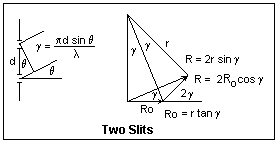
 Let's begin with a single slit of width a, illuminated by collimated
light. At an angle θ = 0, all the wavelets from a wavefront are brought
together at the focal point F, and the total amplitude may be denoted by
Ro, and the intensity will be Io = Ro2.
At an angle θ, wavelets from the bottom of the slit will travel an
extra distance a sin θ with respect to those from the top. This
corresponds to a phase difference of 2β = 2πa sin θ/&lambda. The
plot of the resultant amplitude as we go from top to bottom of the slit
will be a circular arc, subtending an angle of 2β, and of total length Ro.
The vibration curve is a circle, because the phase difference is
proportional to the length of the curve, as in s = rθ. If R is the
length of the chord, the resultant amplitude for the whole slit, and r
is the radius of the arc, then R = 2r sin β. However, Ro = rβ, so r can be eliminated and we find R = Ro(sin β/β) or R = Rosinc β. This is the single-slit Fraunhofer diffraction pattern.
As a becomes comparable to the wavelength, the diffracted light is
distributed in a broad cone. The first minimum of R occurs when the
vibration arc closes into a circle, at β = π.
Let's begin with a single slit of width a, illuminated by collimated
light. At an angle θ = 0, all the wavelets from a wavefront are brought
together at the focal point F, and the total amplitude may be denoted by
Ro, and the intensity will be Io = Ro2.
At an angle θ, wavelets from the bottom of the slit will travel an
extra distance a sin θ with respect to those from the top. This
corresponds to a phase difference of 2β = 2πa sin θ/&lambda. The
plot of the resultant amplitude as we go from top to bottom of the slit
will be a circular arc, subtending an angle of 2β, and of total length Ro.
The vibration curve is a circle, because the phase difference is
proportional to the length of the curve, as in s = rθ. If R is the
length of the chord, the resultant amplitude for the whole slit, and r
is the radius of the arc, then R = 2r sin β. However, Ro = rβ, so r can be eliminated and we find R = Ro(sin β/β) or R = Rosinc β. This is the single-slit Fraunhofer diffraction pattern.
As a becomes comparable to the wavelength, the diffracted light is
distributed in a broad cone. The first minimum of R occurs when the
vibration arc closes into a circle, at β = π.


